Field | Detail |
|---|---|
Client/Company | Microsoft - Customer Innovation APAC |
Role | UX Architect |
Deliverables | Design Strategy, Prioritised Use Cases, Storyboards |
Scope | Discovery and Envisioning (Pre-Sales Stage) |
Timeline | Q1 2023 |
Microsoft's client in the utilities gas sector had identified industrial metaverse technology as a strategic lever for transforming business operations. This engagement saw the Microsoft customer innovation team collaborate directly with the client's senior leadership to identify, prioritise and visualise the use cases that would form the foundation of an industrial metaverse adoption strategy.
As UX Architect, the scope of work covered the discovery and envisioning phases during the pre-sales stage, producing the design artefacts that translated ambitious visions into a concrete, commercially grounded framework.
Due to confidentiality commitments, the specifics of the client's operations and detailed project artefacts cannot be published. This case study demonstrates strategic thinking and design process without compromising any project details.
Challenge
The project's primary focus was on prioritising technology and gaining a competitive advantage by leveraging industrial metaverse solutions. The challenge was significant: beginning from scratch and building something entirely new within the constraints of a pre-sales engagement, where the commercial outcome was still to be secured.
The scope of work sat squarely in the discovery and envisioning phases, with the goal of defining scenarios for immersive experiences across several business units. The deliverables needed to serve a dual purpose: articulating the future state of immersive experiences to the client's senior stakeholders, and equipping the business development team with the artefacts needed to secure commercial agreements.
Working within a hybrid engagement model added further complexity. Stakeholders from both the client and the Microsoft team were distributed across locations, and workshops needed to accommodate participants joining in person and remotely without any loss of fidelity or engagement.
Approach
Discovery
The discovery phase began with internal alignment before any client-facing activity. Kick-off and information sharing sessions were organised to establish the current state across teams, with a structured question set developed for follow-up sessions with the client's key contacts.
Stakeholder interviews were managed end-to-end: preparation documentation, schedule coordination with the client's primary contact, interview scripts and remote facilitation. The synthesis outcomes were distilled into UX artefacts and shared across the internal Microsoft team to establish a shared understanding of the client's current state, business value chain and the technologies Microsoft could offer.
The purpose of these discovery artefacts was deliberate: to align both the client stakeholders and the Microsoft team on the direction for the envisioning phase that followed, ensuring neither side entered workshops with misaligned assumptions.
Use Case Exploration Workshops
With discovery complete, a full-day hybrid workshop was convened, with 20 participants in the room and 10 joining remotely. The workshop was facilitated using Mural and conducted remotely. Logistical preparation covered room configuration, audio, screen setup and the Mural board architecture, all of which were critical to running the session without interruption.
The workshop followed a structured six-stage flow: introduction and alignment on goals, an icebreaker to build rapport across the distributed group, identification of current business challenges, use case ideation, definition of use cases in greater detail, and prioritisation by business impact and effort using immersive experiences as the primary lens.
Prioritisation was rationalised using sticky note counts and votes, weighted against business considerations. Six use case areas emerged:
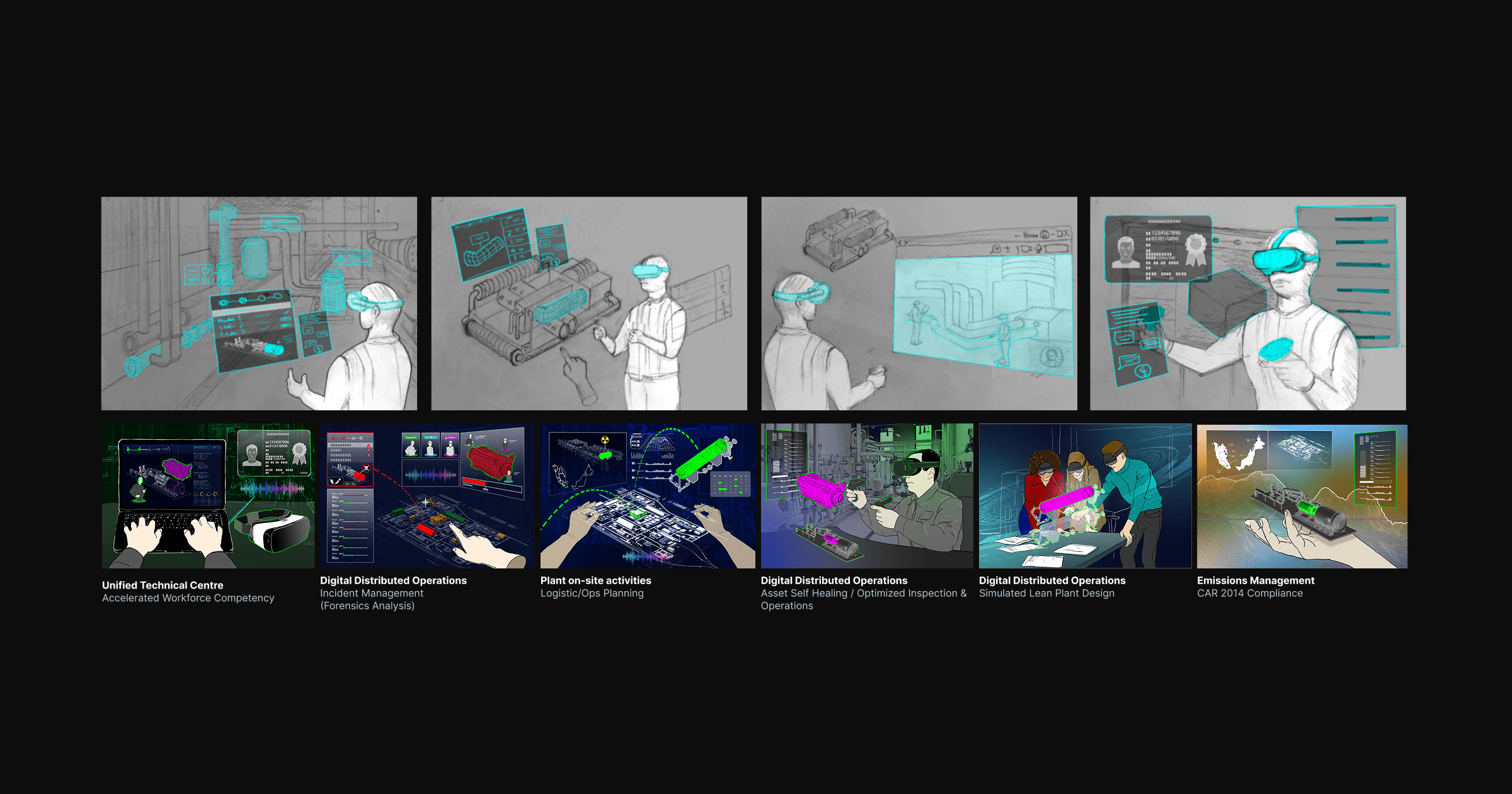
Unified Technical Centre — Accelerated Workforce Competency
Digital Distributed Operations — Incident Management (Forensics Analysis)
Digital Distributed Operations — Asset Self Healing and Optimised Inspection
Digital Distributed Operations — Simulated Lean Plant Design
Plant On-Site Activities — Logistics and Operations Planning
Emissions Management — CAR 2014 Compliance
Visualisation of Prioritised Use Cases
Following the workshop, the prioritised use cases were rendered as key visuals to give the client's senior leaders a concrete, readable picture of each scenario's context. The visual approach required keyword-driven descriptions embedded into each key visual to build the final use case list, with each use case refined in greater detail across business value, users, partners, datasets and potential blockers or risks.
Storyboard Creation
Scenario ideation workshops were conducted to define key personas and user journeys for each prioritised use case. These journeys formed the basis for the storyboards, produced in a lo-fi hand-drawing style appropriate to the early milestone stage.
One representative scenario followed a field operator through a complete AR/VR-assisted training cycle: authenticating and entering the plant environment with a headset, following augmented standard operating procedures guided by an AI coach, connecting via Teams with a supervisor for troubleshooting, and completing a knowledge check to receive certification. All required immersive experience information was injected into the visuals following the user journey, keeping the narrative coherent from first contact through to completion.
Outcome
After delivering the prioritised use cases and storyboards, the business development team secured the commercial agreements needed to advance the engagement. The discovery and envisioning output provided the foundation for the next phase: architecture design sessions and rapid prototyping.
The engagement demonstrated the value of a structured, human-centred approach to industrial metaverse adoption. Starting from scratch, with no precedent within the client's organisation, the process produced a commercially viable output within the pre-sales window, giving the client's senior leadership a clear visual picture of the opportunities available and the confidence to commit to the next phase of investment.
Field | Detail |
|---|---|
Client/Company | Microsoft - Customer Innovation APAC |
Role | UX Architect |
Deliverables | Design Strategy, Prioritised Use Cases, Storyboards |
Scope | Discovery and Envisioning (Pre-Sales Stage) |
Timeline | Q1 2023 |
Microsoft's client in the utilities gas sector had identified industrial metaverse technology as a strategic lever for transforming business operations. This engagement saw the Microsoft customer innovation team collaborate directly with the client's senior leadership to identify, prioritise and visualise the use cases that would form the foundation of an industrial metaverse adoption strategy.
As UX Architect, the scope of work covered the discovery and envisioning phases during the pre-sales stage, producing the design artefacts that translated ambitious visions into a concrete, commercially grounded framework.
Due to confidentiality commitments, the specifics of the client's operations and detailed project artefacts cannot be published. This case study demonstrates strategic thinking and design process without compromising any project details.
Challenge
The project's primary focus was on prioritising technology and gaining a competitive advantage by leveraging industrial metaverse solutions. The challenge was significant: beginning from scratch and building something entirely new within the constraints of a pre-sales engagement, where the commercial outcome was still to be secured.
The scope of work sat squarely in the discovery and envisioning phases, with the goal of defining scenarios for immersive experiences across several business units. The deliverables needed to serve a dual purpose: articulating the future state of immersive experiences to the client's senior stakeholders, and equipping the business development team with the artefacts needed to secure commercial agreements.
Working within a hybrid engagement model added further complexity. Stakeholders from both the client and the Microsoft team were distributed across locations, and workshops needed to accommodate participants joining in person and remotely without any loss of fidelity or engagement.
Approach
Discovery
The discovery phase began with internal alignment before any client-facing activity. Kick-off and information sharing sessions were organised to establish the current state across teams, with a structured question set developed for follow-up sessions with the client's key contacts.
Stakeholder interviews were managed end-to-end: preparation documentation, schedule coordination with the client's primary contact, interview scripts and remote facilitation. The synthesis outcomes were distilled into UX artefacts and shared across the internal Microsoft team to establish a shared understanding of the client's current state, business value chain and the technologies Microsoft could offer.
The purpose of these discovery artefacts was deliberate: to align both the client stakeholders and the Microsoft team on the direction for the envisioning phase that followed, ensuring neither side entered workshops with misaligned assumptions.
Use Case Exploration Workshops
With discovery complete, a full-day hybrid workshop was convened, with 20 participants in the room and 10 joining remotely. The workshop was facilitated using Mural and conducted remotely. Logistical preparation covered room configuration, audio, screen setup and the Mural board architecture, all of which were critical to running the session without interruption.
The workshop followed a structured six-stage flow: introduction and alignment on goals, an icebreaker to build rapport across the distributed group, identification of current business challenges, use case ideation, definition of use cases in greater detail, and prioritisation by business impact and effort using immersive experiences as the primary lens.
Prioritisation was rationalised using sticky note counts and votes, weighted against business considerations. Six use case areas emerged:
Unified Technical Centre — Accelerated Workforce Competency
Digital Distributed Operations — Incident Management (Forensics Analysis)
Digital Distributed Operations — Asset Self Healing and Optimised Inspection
Digital Distributed Operations — Simulated Lean Plant Design
Plant On-Site Activities — Logistics and Operations Planning
Emissions Management — CAR 2014 Compliance
Visualisation of Prioritised Use Cases
Following the workshop, the prioritised use cases were rendered as key visuals to give the client's senior leaders a concrete, readable picture of each scenario's context. The visual approach required keyword-driven descriptions embedded into each key visual to build the final use case list, with each use case refined in greater detail across business value, users, partners, datasets and potential blockers or risks.
Storyboard Creation
Scenario ideation workshops were conducted to define key personas and user journeys for each prioritised use case. These journeys formed the basis for the storyboards, produced in a lo-fi hand-drawing style appropriate to the early milestone stage.
One representative scenario followed a field operator through a complete AR/VR-assisted training cycle: authenticating and entering the plant environment with a headset, following augmented standard operating procedures guided by an AI coach, connecting via Teams with a supervisor for troubleshooting, and completing a knowledge check to receive certification. All required immersive experience information was injected into the visuals following the user journey, keeping the narrative coherent from first contact through to completion.
Outcome
After delivering the prioritised use cases and storyboards, the business development team secured the commercial agreements needed to advance the engagement. The discovery and envisioning output provided the foundation for the next phase: architecture design sessions and rapid prototyping.
The engagement demonstrated the value of a structured, human-centred approach to industrial metaverse adoption. Starting from scratch, with no precedent within the client's organisation, the process produced a commercially viable output within the pre-sales window, giving the client's senior leadership a clear visual picture of the opportunities available and the confidence to commit to the next phase of investment.
Case study walkthroughs available upon request.
Case study walkthroughs available upon request.
© 2026 Mokujiro Studio
© 2026 Mokujiro Studio