MokuDocs
Shipped a complete, dependency-free documentation template on the Framer Marketplace
Field | Detail |
|---|---|
Product | MokuDocs |
Type | Framer Marketplace Template |
Scope | Product design, CMS architecture, component engineering, marketplace listing, marketing |
Platform | Framer |
Launch date | April 11, 2026 |
Marketplace listing | Documentation / SaaS / Landing Page |
Preview URL | |
Studio | Mokujiro Studio |
Location | Melbourne, Australia |
Designer / Engineer | Ken Tai |
Intro
MokuDocs is a documentation template built for the Framer Marketplace — a fully CMS-powered docs site that gives SaaS teams, founders, and Framer designers a polished starting point without the weeks of setup. It launched on the Framer Marketplace on April 11, 2026.
The product was conceived and built entirely in-house at Mokujiro Studio — designed, engineered, and shipped as a commercial template product, not a client project.
Challenge
Documentation sites are deceptively hard to build well. The structural requirements alone — sidebar navigation, search, table of contents, dark mode, bookmarks, reading progress — add up quickly. And most teams reach for third-party platforms to handle the complexity, which means external accounts, integrations to maintain, and content that lives outside the product.
The goal for MokuDocs was direct: build a documentation template that runs entirely on native Framer CMS, with no external dependencies, and ships with everything a team needs to publish real documentation from day one.
The additional constraint was Marketplace-readiness. Framer's marketplace has its own quality bar — submission categories, visual previews, feature tags, and a listing description that has to communicate what the template does and who it is for, immediately.
Approach
Architecture
The CMS schema was the core design decision. Rather than building a flat page structure, MokuDocs uses a category-based architecture: each documentation article belongs to a category, and the sidebar renders from that relationship. This means buyers can create new categories and articles entirely through the Framer CMS panel — no code changes needed.
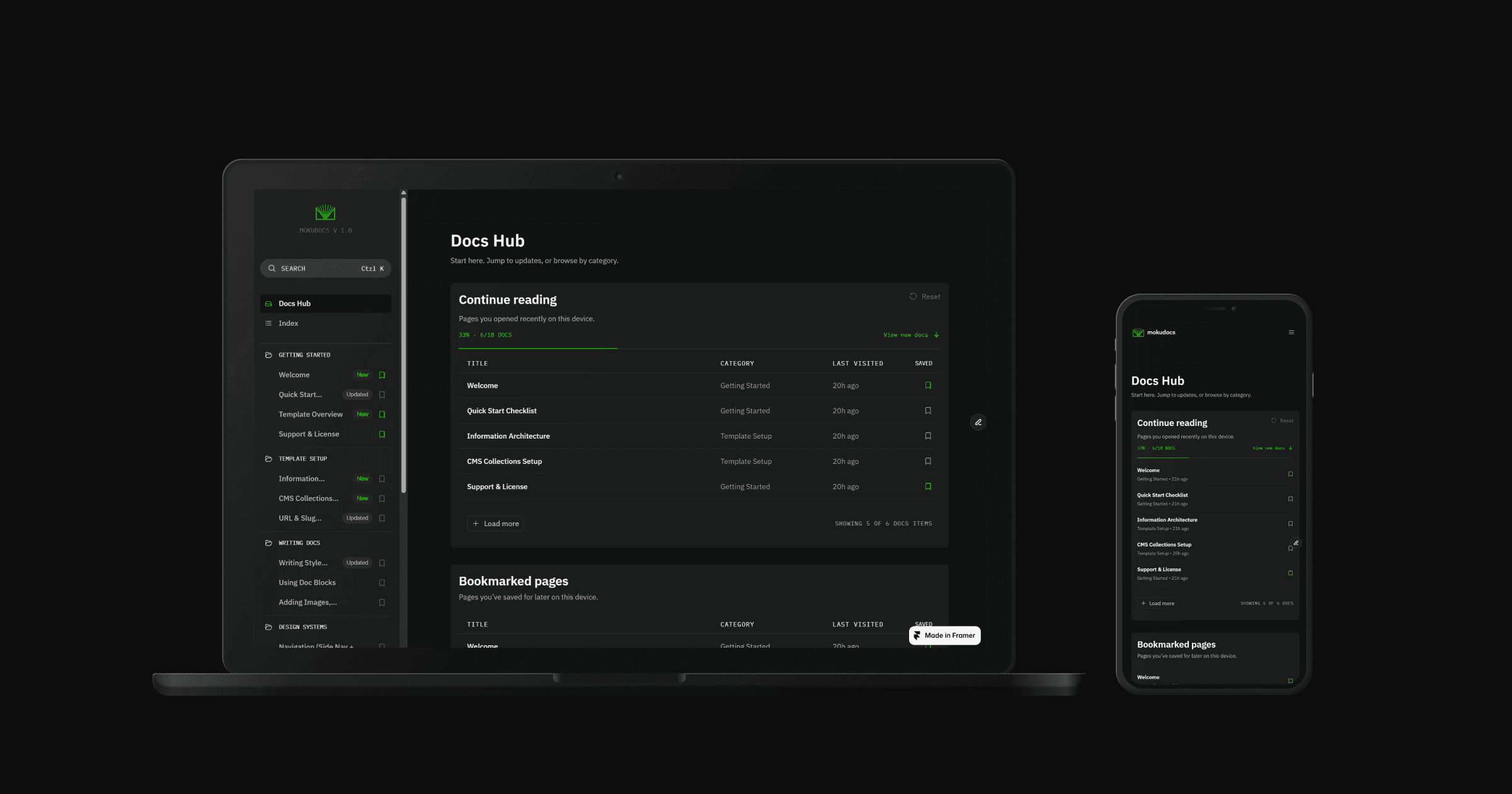
The sidebar navigation uses accordion behaviour with active states, driven by CMS data. The Docs Hub renders a structured overview of all published categories and surfaces "New" and "Updated" badges from CMS-controlled fields.
Search
Site-wide search was implemented using a Cmd+K modal — the standard keyboard shortcut that developers recognise immediately. No Algolia account. No API key. No external search index. The search queries CMS content directly, keeping the full implementation within Framer's native environment.
Reading Experience
Three reading-support features were built as native components: a reading progress bar on every doc page, an auto-generated table of contents built from headings, and a bookmark and continue reading system. These features are standard expectations in commercial documentation products. Building them natively kept the template dependency-free and buyer-maintainable.
Visual Design
The template was designed dark-first, with a manual light/dark mode toggle available on every page. The visual language is minimal and professional: high contrast, clean typography, structured whitespace. The template ships with 18+ sample documentation pages across multiple categories, giving buyers a realistic content scaffold to work from.
Submission Strategy
The Framer Marketplace submission required deliberate scoping decisions before launch. A draft category was removed from the Docs Hub featured list — five complete published categories is a stronger first impression than five plus one that behaves inconsistently. An undocumented Pages CMS collection was audited and cleared before listing.
Before submission, the template was audited against Framer's full marketplace criteria — including accessibility requirements: aria labels, image alt text, tab index, semantic HTML tags, and colour contrast. Every item was resolved before listing.
Outcome
MokuDocs went live on the Framer Marketplace on April 11, 2026, across three categories: Documentation, SaaS, and Landing Page.
The template shipped complete: sidebar navigation, Cmd+K search, dark and light mode, bookmarks, reading progress, table of contents, breadcrumbs, previous/next navigation, FAQ page, custom 404, and 18+ sample docs — all running on native Framer CMS.
The marketplace launch was supported by an Instagram Reel campaign showing the live site in motion, prioritising Explore reach and new-audience acquisition over engagement from existing followers.
MokuDocs
Shipped a complete, dependency-free documentation template on the Framer Marketplace
Field | Detail |
|---|---|
Product | MokuDocs |
Type | Framer Marketplace Template |
Scope | Product design, CMS architecture, component engineering, marketplace listing, marketing |
Platform | Framer |
Launch date | April 11, 2026 |
Marketplace listing | Documentation / SaaS / Landing Page |
Preview URL | |
Studio | Mokujiro Studio |
Location | Melbourne, Australia |
Designer / Engineer | Ken Tai |
Intro
MokuDocs is a documentation template built for the Framer Marketplace — a fully CMS-powered docs site that gives SaaS teams, founders, and Framer designers a polished starting point without the weeks of setup. It launched on the Framer Marketplace on April 11, 2026.
The product was conceived and built entirely in-house at Mokujiro Studio — designed, engineered, and shipped as a commercial template product, not a client project.
Challenge
Documentation sites are deceptively hard to build well. The structural requirements alone — sidebar navigation, search, table of contents, dark mode, bookmarks, reading progress — add up quickly. And most teams reach for third-party platforms to handle the complexity, which means external accounts, integrations to maintain, and content that lives outside the product.
The goal for MokuDocs was direct: build a documentation template that runs entirely on native Framer CMS, with no external dependencies, and ships with everything a team needs to publish real documentation from day one.
The additional constraint was Marketplace-readiness. Framer's marketplace has its own quality bar — submission categories, visual previews, feature tags, and a listing description that has to communicate what the template does and who it is for, immediately.
Approach
Architecture
The CMS schema was the core design decision. Rather than building a flat page structure, MokuDocs uses a category-based architecture: each documentation article belongs to a category, and the sidebar renders from that relationship. This means buyers can create new categories and articles entirely through the Framer CMS panel — no code changes needed.
The sidebar navigation uses accordion behaviour with active states, driven by CMS data. The Docs Hub renders a structured overview of all published categories and surfaces "New" and "Updated" badges from CMS-controlled fields.
Search
Site-wide search was implemented using a Cmd+K modal — the standard keyboard shortcut that developers recognise immediately. No Algolia account. No API key. No external search index. The search queries CMS content directly, keeping the full implementation within Framer's native environment.
Reading Experience
Three reading-support features were built as native components: a reading progress bar on every doc page, an auto-generated table of contents built from headings, and a bookmark and continue reading system. These features are standard expectations in commercial documentation products. Building them natively kept the template dependency-free and buyer-maintainable.
Visual Design
The template was designed dark-first, with a manual light/dark mode toggle available on every page. The visual language is minimal and professional: high contrast, clean typography, structured whitespace. The template ships with 18+ sample documentation pages across multiple categories, giving buyers a realistic content scaffold to work from.
Submission Strategy
The Framer Marketplace submission required deliberate scoping decisions before launch. A draft category was removed from the Docs Hub featured list — five complete published categories is a stronger first impression than five plus one that behaves inconsistently. An undocumented Pages CMS collection was audited and cleared before listing.
Before submission, the template was audited against Framer's full marketplace criteria — including accessibility requirements: aria labels, image alt text, tab index, semantic HTML tags, and colour contrast. Every item was resolved before listing.
Outcome
MokuDocs went live on the Framer Marketplace on April 11, 2026, across three categories: Documentation, SaaS, and Landing Page.
The template shipped complete: sidebar navigation, Cmd+K search, dark and light mode, bookmarks, reading progress, table of contents, breadcrumbs, previous/next navigation, FAQ page, custom 404, and 18+ sample docs — all running on native Framer CMS.
The marketplace launch was supported by an Instagram Reel campaign showing the live site in motion, prioritising Explore reach and new-audience acquisition over engagement from existing followers.
Case study walkthroughs available upon request.
Case study walkthroughs available upon request.
© 2026 Mokujiro Studio
© 2026 Mokujiro Studio